Active preschooler's room


Active Preschooler's Room: A Space That Keeps Up with Your Child
A preschooler's room is no longer just a place to sleep and store clothes. It's a small world where children rest, play, build, jump, arrange, hide treasures, scatter blocks, invent stories, and increasingly try to do things "independently."
And if a child is active, curious about the world and has a lot of energy, the room must be more than just a nice interior with childish accessories.
It must work.
An active preschooler's room needs a good plan
Decorating a preschooler's room often starts with choosing a theme: forest, safari, space, dinosaurs, ocean, unicorns, cars, princesses, or a neutral, calm style without a clear theme.
This is a good starting point, but a theme alone is not enough.
In an active child's room, the most important thing is whether the space helps with everyday functioning.
Is there room for movement?
Does the child have a place to calm down?
Are the toys accessible but not overwhelming?
Is the bed not blocked?
Is it possible to clean up quickly?
Does the room layout support fun and not generate constant chaos?
Because an active preschooler doesn't need a room that only looks good for five minutes after being cleaned. They need a space that can handle real life.

A nice room is not enough - it must also match your interior
Online inspiration can look beautiful. The problem is that it usually shows large, bright rooms with perfect proportions, high ceilings, and furniture placed in a space that has nothing in common with your home.
Meanwhile, a real child's room can be narrow, small, walk-through, with a sloping ceiling, a difficult window, a radiator in the wrong place or a wardrobe that can't be moved.
That's why at Miejsce, we work from a photo of your room. We don't show abstract inspiration, but rather a possible design direction embedded in a specific space.
It's a bit like an interior pre-designed by an architect - only tailored to the realities of your room: its layout, light, proportions and possibilities.
What should be in an active preschooler's room?
With an active child, it's worth thinking of the room as several zones rather than a collection of individual pieces of furniture.
You need a sleep zone – as quiet as possible, without too much stimulation, right next to your bed.
You need a play area where your child has room to set up blocks, figures, tracks, puzzles or play a themed game.
It's good if there's also a small quiet corner: a soft mattress, a tent, a canopy, a pouffe, a bookshelf or a cozy place where the child can retreat.
Movement-enhancing elements also work well in an active preschooler's room—but they don't have to turn the room into a gymnasium. Sometimes all you need is a soft rug, a low ladder, a rocker, a mattress, a small activity wall, a balance beam, or a space left intentionally empty so your child has a place to build, jump, and invent games.
The most important thing is that activity doesn't conflict with rest. The room should allow the child to move, but still help them wind down in the evening.
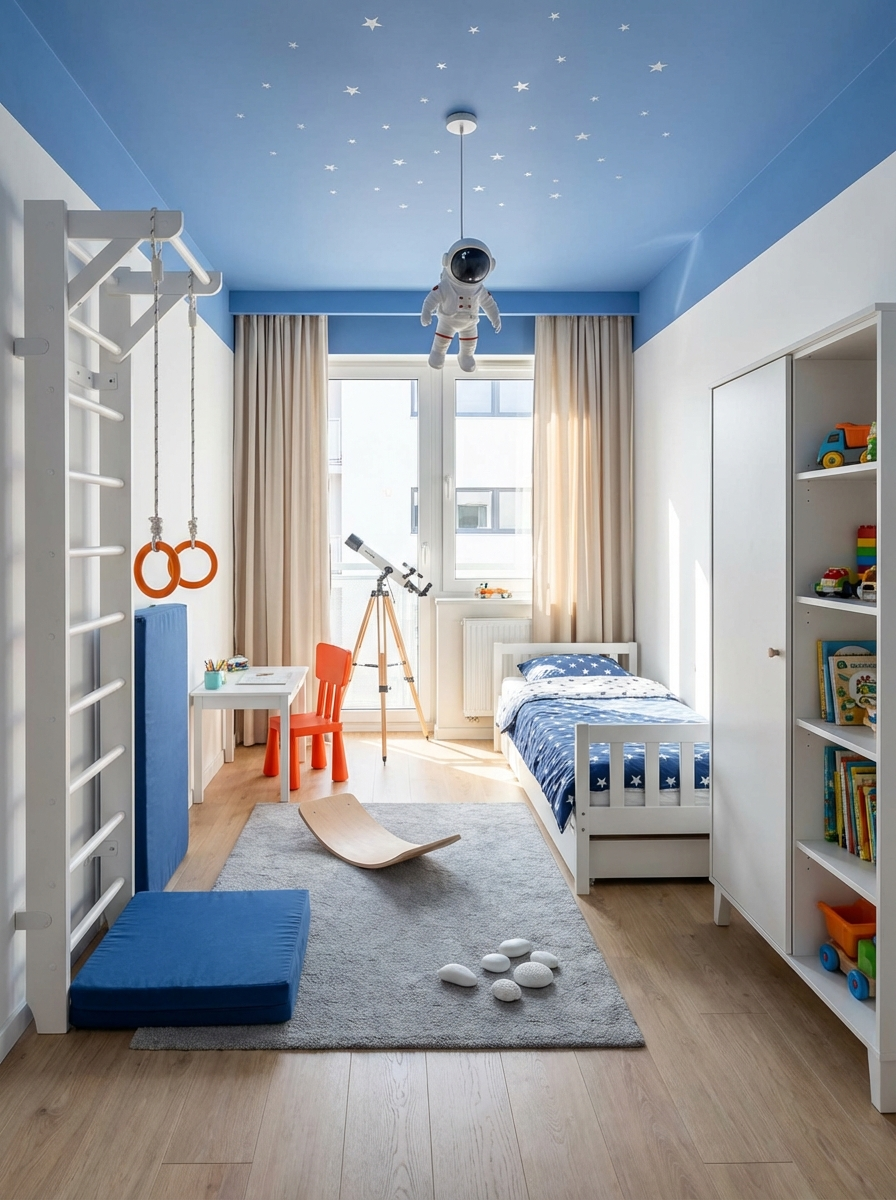
A room adapted to the child's temperament
At Miejsce, in higher packages, you can match the concept not only to the photo of the room and the chosen style, but also to the child's temperament .
The space needs to be designed differently for a preschooler who needs a lot of movement, stimulation, and space for free play, than for a child who is more easily stimulated and needs a calmer base, a quiet corner, and a more orderly environment.
Thanks to this, you receive a proposal that is not just a nice arrangement in a chosen theme, but a direction tailored to your child, their energy, daily rhythm and daily needs .
Less random things, more conscious decisions
It's very easy to impulse buy things for a preschooler. Partly because baby items are simply adorable, and partly because parents often try to solve every problem with another product.
Messy? Let's buy more boxes.
Is your child bored? Let's buy a new toy.
Does the room look empty? Let's add stickers, lamps, posters, and a rug.
Lacking some atmosphere? Maybe wallpaper, a canopy, a house, an armchair, a chalkboard, and a bookshelf.
As a result, the room quickly becomes overcrowded. The child has a lot of stimulation, the parent has a lot of cleaning to do, and the interior loses its cohesiveness.
A space helps you see the whole picture before you buy. You can check if the chosen theme really suits the room , if the colors aren't too strong, and whether it's better to opt for one larger decorative element or a calm base with easily interchangeable accessories.

See before you buy
Visualizing an active preschooler's room allows you to stop before making costly decisions.
You can see what a forest atmosphere with greenery and wood would look like in your room.
Or a safari room with warm beige tones, animal accents and room for movement.
You can test whether a space theme would work better on one wall or in accessories. A pastel room with unicorns might be too sweet.
Can dinosaurs look modern and not like a random collection of stickers?
This isn't a decision about a single image. It's a decision about direction.
And the direction is worth seeing before you start buying a bed, wardrobe, shelf, carpet, lamp, wallpaper and decorations.
You don't need to know how to achieve this effect
The visualization itself shows what the room might look like. But often, the question arises only later: how can this be translated into a real interior?
In the Smart and Premium packages you receive practical tips that help you understand the effect shown in the visualization.
We advise you on what type of furniture to look for, what colors and materials will match, which elements are most important for the interior's atmosphere, and what should be omitted so as not to overload the room.
This is especially important for an active preschooler, as the room must be not only aesthetically pleasing, but also resistant to everyday life.
These tips help you think about storage, open space, soft surfaces, play and quiet areas—what really impacts child and parent comfort.
You don't need to be an expert in interior design . You'll get visual direction and practical tips on how to achieve this effect in a real room.
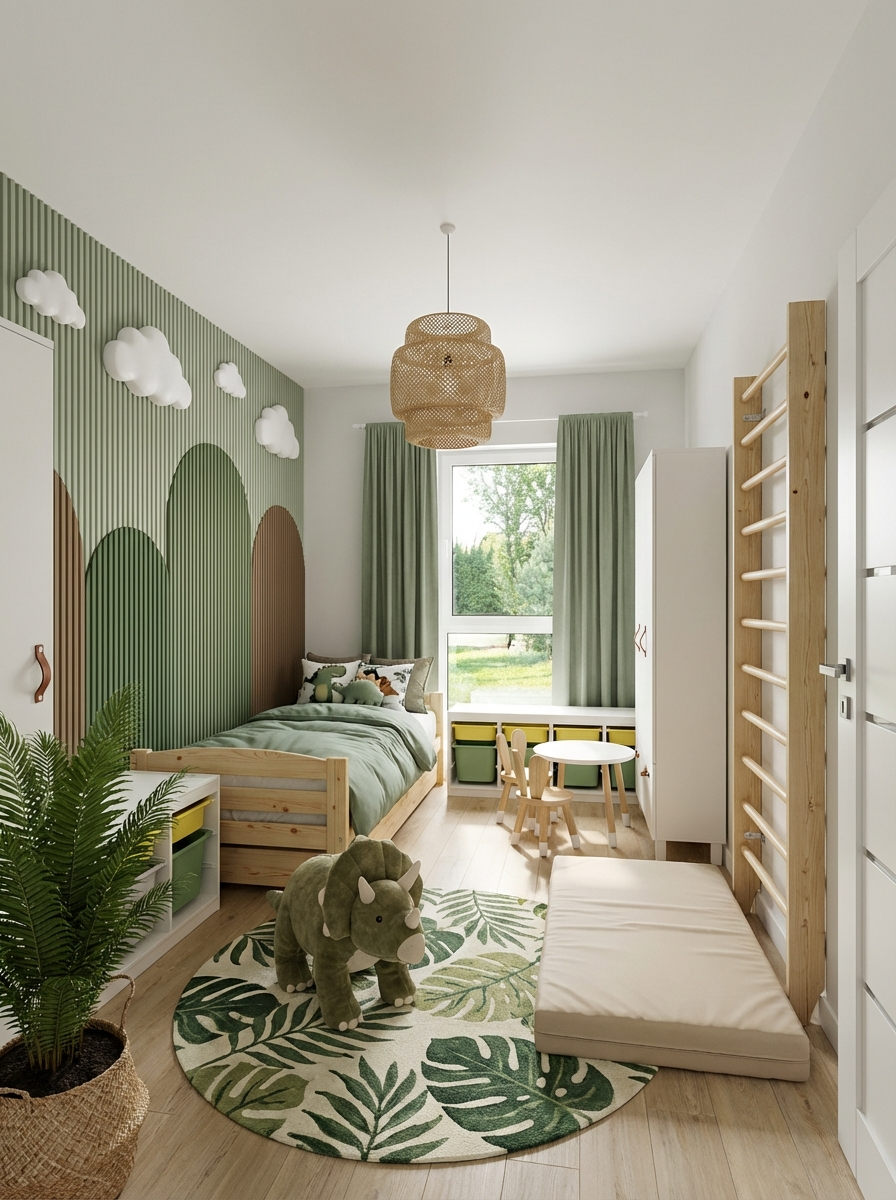
A good preschool room grows with the child
A preschooler changes very quickly. Today, they need space for tracks, figurines, and puzzles; soon, they'll need a drawing table, more books, a bigger bed, or space for their first independent hobby.
Therefore, when decorating a room, it is worth avoiding solutions that are too literal and too difficult to change.
The theme may be present, but it does not have to take over the entire space.
Sometimes it's better to choose neutral furniture, a good color base, and one stronger element: wallpaper, a mural, a carpet, a lamp, a tent, a rocking chair, or a wall decoration.
This way the room still has character, but doesn't get old after a few months.
An active preschooler's room can be beautiful, practical and peaceful at the same time.
It doesn't have to be a choice between aesthetics and functionality. A room can look good, support play, provide space for movement, and simultaneously help a child calm down.
The key is to understand the whole thing before you start buying individual items .
Space helps you see how your chosen style, color scheme, and layout might work in your space. Based on a photo of the room, we create visualizations that showcase the interior's true potential—and in Smart and Premium packages, we add tips on how to achieve this effect without guesswork.
Because an active preschooler's room shouldn't just be pretty.
It should be a space that keeps up with the child – and makes life easier for parents.

See what your room can become
At Miejsce you don't choose ready-made inspiration from a catalog.
You show us your interior, and we help you see its potential—in a specific style, color scheme, and layout tailored to your space.
It's a simple way to check whether your chosen direction really makes sense before purchasing furniture, paint, and accessories. And if you choose the Smart or Premium package, you'll receive not only visualizations but also practical tips on how to achieve the same effect in a real room.
Instead of guessing, buying blindly and assembling an interior from random elements, you can first see the whole thing - and only then consciously plan your child's room.

Comments